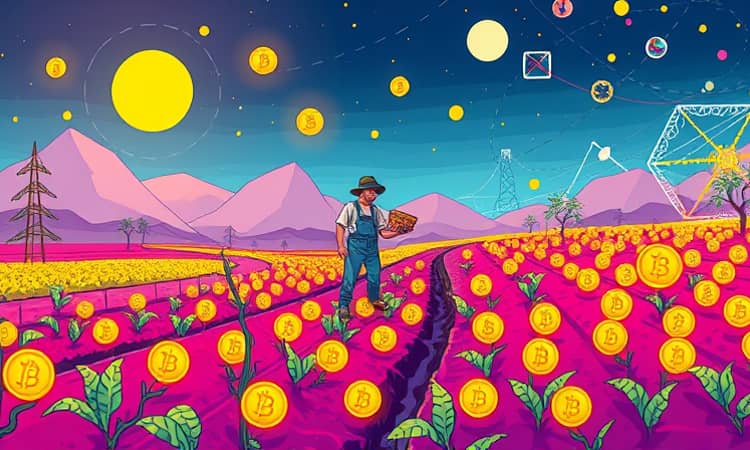
In the ever-evolving world of decentralized finance, yield farming emerges as a powerful way to grow your digital wealth.
It transforms passive holding into an active, income-generating venture, much like tending to a fertile field.
By leveraging automated market makers (AMMs), users can tap into multiple revenue streams across blockchain networks.
This practice allows you to earn rewards by providing liquidity to decentralized exchanges, fostering a permissionless financial ecosystem.
Imagine cultivating your assets to harvest returns from every possible direction, turning idle crypto into a dynamic source of income.
The journey begins with understanding the core mechanics and embracing the proactive mindset required for success.
What Is Yield Farming?
Yield farming is the practice of staking or lending cryptocurrency assets in DeFi protocols to earn rewards.
It primarily involves providing liquidity to decentralized exchanges and other platforms, enabling token swaps without intermediaries.
Users become liquidity providers (LPs) by depositing assets into liquidity pools, which are powered by smart contracts on blockchains like Ethereum.
This process helps bootstrap DeFi growth by distributing tokens to valuable participants, creating long-term communities.
Rewards can come in various forms, including transaction fees, interest, and governance tokens, offering diverse income angles.
How Yield Farming Works
The mechanics of yield farming are straightforward but require careful navigation.
Start by providing liquidity, such as depositing paired tokens like ETH/USDT into a pool on a platform like Uniswap or Curve.
You earn a share of trading fees proportional to your contribution, which contributes to your annual percentage yield (APY).
After depositing, you receive LP tokens that represent your stake in the pool.
These tokens can be staked on the same or another platform to earn additional rewards, such as governance tokens like CRV or COMP.
To maximize returns, many farmers compound their earnings by reinvesting rewards back into the pools.
This can be automated through yield aggregators or vaults, which optimize strategies across multiple protocols.
Unlike passive staking, yield farming involves proactive management, including shifting assets to chase the highest yields.
Key steps include:
- Providing liquidity with paired assets.
- Earning rewards from fees and tokens.
- Staking LP tokens for extra yields.
- Compounding returns through reinvestment.
- Employing advanced tactics like leverage.
Key Strategies for Maximizing Yields
To cultivate income effectively, diversify your approach across various strategies.
Liquidity provision is the core method, offering fixed or fluctuating yields from pools on DEXes.
Staking LP tokens can generate additional governance tokens rewards, enhancing your overall returns.
Automated yield aggregators use smart contracts to navigate multiple protocols for optimal APY, reducing manual effort.
Liquidity mining involves earning specific rewards for provisioning liquidity or contributing to protocol growth.
Leveraged farming amplifies your positions for higher potential yields, though it comes with increased risk.
Token swapping and reinvesting convert rewards into principal to boost compounding effects.
These strategies enable diversification across:
- Decentralized exchanges (DEXes) like Uniswap and SushiSwap.
- Lending protocols for borrowing and lending yields.
- Multi-chain setups to access broader opportunities.
- Short- and long-term return maximization.
Understanding Rewards and Metrics
Rewards in yield farming are expressed through metrics like APY and APR, which include fees and token incentives.
APY accounts for compounding, while APR does not, making it crucial to understand which metric a platform uses.
Yields can decrease as pools fill with more liquidity, so staying informed is key.
Diverse incentives include trading fees, interest, and governance tokens, which can grow your holdings exponentially through reinvestment.
Platforms often display real-time APY to help users make informed decisions.
Total value locked (TVL) is another important metric, indicating the health and popularity of a protocol.
Examples show that yields are dynamic and incentivize active management, similar to high-density yields in agriculture.
To illustrate, here is a comparison of common yield farming strategies:
Risks and How to Mitigate Them
Yield farming is not without its challenges, and understanding risks is essential for sustainable growth.
Impermanent loss occurs when the value of pooled assets diverges, reducing returns compared to holding.
Smart contract vulnerabilities pose threats from bugs or hacks in AMMs, requiring thorough audits.
Rug pulls by malicious projects can drain funds, emphasizing the need for due diligence.
Market volatility leads to fluctuating rates and token depreciation, impacting yields.
High gas fees on Ethereum-based protocols can erode profits, but Layer-2 solutions offer mitigation.
To protect your investments, consider these risk mitigation strategies:
- Diversify across protocols and assets.
- Use insured platforms or protocols with audits.
- Start small to test strategies.
- Monitor market conditions regularly.
- Employ stop-loss mechanisms if available.
Remember, yield farming demands proactive management, unlike passive staking.
Popular Platforms and Examples
Several platforms dominate the yield farming landscape, each offering unique opportunities.
Decentralized exchanges like Uniswap, SushiSwap, Curve, and Balancer are popular for liquidity provision.
Lending protocols integrate with these to provide borrowing and lending yields, expanding income angles.
Yield aggregators automate optimization across multiple protocols, simplifying the process for users.
Examples include Yearn Finance for vault strategies and Beefy Finance for multi-chain yields.
These platforms have bootstrapped DeFi growth by distributing tokens and fostering communities.
Key platforms to explore:
- Uniswap for Ethereum-based swaps.
- Curve for stablecoin pools.
- Balancer for customizable pools.
- SushiSwap for community-driven rewards.
- Yearn Finance for automated strategies.
The Agricultural Analogy: Why It Fits
The title "Cultivating Income from Every Angle" draws a powerful parallel with traditional farming.
Yield farming is proactive, akin to crop rotation for maximizing returns, rather than passive holding.
It achieves high-density yields per unit of capital, similar to vertical farming's efficiency.
Resilience in volatile markets mirrors organic farming's performance in droughts, offering stability.
By stacking strategies like crops and controlling conditions through protocol selection, you can harvest year-round.
This analogy highlights the innovation in DeFi, where digital assets are cultivated for growth.
Just as urban farms yield more per acre, yield farming leverages technology for superior returns.
Embrace this mindset to navigate the DeFi landscape with confidence and creativity.
Getting Started with Yield Farming
Beginning your yield farming journey requires preparation and caution.
First, set up a Web3 wallet like MetaMask to interact with DeFi protocols securely.
Acquire some cryptocurrency, such as ETH or stablecoins, to use as initial capital.
Research platforms and strategies, focusing on those with good reputations and audits.
Start with small amounts to learn the ropes without exposing yourself to significant risk.
Use yield aggregators to automate processes if you're new to active management.
Steps to get started:
- Choose a reliable wallet and fund it.
- Select a platform like Uniswap for initial liquidity provision.
- Deposit paired tokens into a liquidity pool.
- Stake LP tokens for extra rewards if available.
- Reinvest earnings to compound returns.
Always prioritize security and continuous learning to adapt to market changes.
Future of Yield Farming
The future of yield farming looks promising, with ongoing innovations and expansions.
Cross-chain interoperability will enable access to more protocols and assets across different blockchains.
Improved risk management tools, such as insurance products, will make farming safer for users.
Yield aggregators will become more sophisticated, offering personalized strategies based on user goals.
Regulatory developments may shape the landscape, but the core permissionless nature is likely to persist.
As DeFi matures, expect more stable yields and reduced volatility, akin to resilience in agricultural systems.
Embrace these trends to stay ahead and continue cultivating income from every angle in the evolving financial ecosystem.
With dedication and smart strategies, yield farming can be a rewarding part of your financial portfolio.