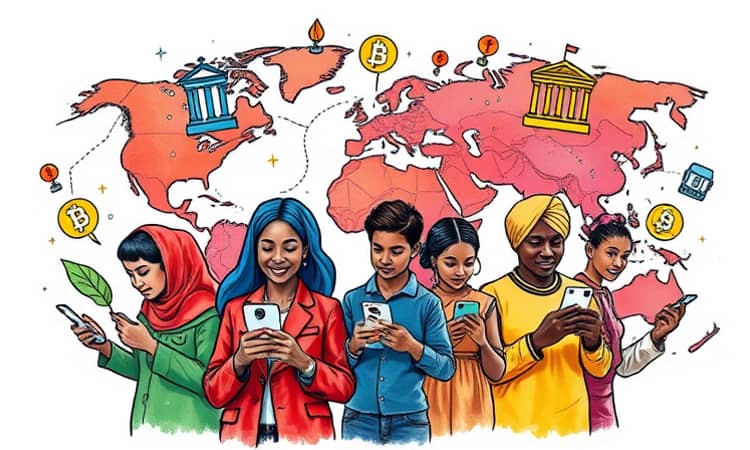
FinTech is no longer a niche segment but a catalyst reshaping how people and businesses access financial services. From urban centers to rural villages, digital solutions are closing gaps that traditional banking has left open.
Emerging markets stand on the brink of a financial revolution, driven by a convergence of innovative technologies and growing demand for accessible, efficient services.
A Rapidly Expanding Global Market
According to industry forecasts, the global fintech market valued at $394.88 billion in 2025 is projected to reach $1,126.64 billion by 2032 at a 16.2% CAGR. Revenues grew 21% year-over-year in 2024, outpacing broader financial services by threefold.
By 2034, analysts estimate the sector could swell to $1.76 trillion, fueled by embedded finance, super apps, and fintech-as-a-service models. The GCC region alone is poised for substantial gains, with its fintech market hitting $10.5 billion in 2025.
Bridging the Gap in Emerging Economies
Despite its momentum, fintech captures only 3–5% of global banking revenue, indicating substantial room for growth in emerging markets. Regulatory initiatives and digital inclusion programs are aligning to extend services to underbanked populations.
Innovations such as stablecoins now process $9 trillion in payments annually, offering settlement time from days to seconds for B2B invoices in Latin America and the Middle East. Meanwhile, dynamic credit scoring using rental and transaction data is unlocking loans for gig workers and thin-file borrowers.
Key Technologies Driving FinTech Adoption
Several core trends are converging to propel fintech adoption in developing regions:
- AI accounts for 58% of VC investments in 2025, powering risk assessment, compliance automation, and personalized user experiences.
- Blockchain and stablecoins have enabled cross-border commerce, with stablecoins processed $9 trillion in payments and 87% growth from the previous year.
- Embedded finance integrates payments and lending directly into platforms, transforming ERPs and gig marketplaces.
- Real-time payment rails like India’s UPI, which UPI recorded 170 billion transactions in 2024, are redefining expectations for instant settlement.
- Other emerging tools include tokenization of assets, quantum-safe security, and streaming credit scores updating in real time.
Regional Highlights and Success Stories
Each geography brings unique drivers and success stories:
Latin America: With 40.1% of fintech firms focusing on B2B solutions, businesses are leveraging stablecoins to hedge currency volatility and accelerate cross-border payments.
Middle East (GCC): A $10.5 billion market in 2025, the region is investing heavily in digital banking to serve underbanked populations and integrate remittance services.
India and APAC: UPI’s explosive growth underscores demand for real-time consumer payments, while remittance platforms and BNPL solutions are booming among Millennials and Gen Z.
Navigating Challenges and Risks
Despite the promise, fintech ventures face hurdles that can stifle growth and undermine trust.
- Talent shortage affects 23.4% of fintechs, limiting innovation and product development.
- Regulatory complexity contributes to the failure of 73% of startups within three years.
- Fraud prevention and security require balancing speed with robust safeguards to protect consumer data.
- Increased scrutiny of BNPL schemes to ensure consumer protection and responsible lending.
Looking Ahead: Predictions for 2026 and Beyond
As we move into 2026, several patterns will shape the next wave of fintech development:
Fastest-growing companies like Bilt Rewards and Quantinuum demonstrate the power of niche, value-chain focused offerings. Stablecoins and API-first cross-border platforms will continue to erode traditional correspondent banking, emphasizing transparency and speed.
We anticipate a surge in IPOs and M&A activity in early 2026, as investors seek to capitalize on profitable growth trajectories. The rise of streaming credit scores will enable lenders to make decisions based on real-time data feeds, enhancing access for gig workers and small enterprises.
Merchants increasingly view payments as a competitive differentiator, with 49% exploring digital wallets, A2A, and BNPL for cross-border commerce. Meanwhile, Gen Z’s near-universal adoption of mobile wallets and P2P platforms signals that consumer expectations for seamless digital experiences will only intensify.
FinTech in emerging markets is not just an extension of a trend—it is a fundamental shift in how financial services are created, delivered, and consumed. By harnessing dynamic credit scoring using alternative data and embedding finance into everyday platforms, innovators are unlocking new economic pathways.
The interplay between regulators, traditional banks, and agile startups will determine how quickly these markets mature. Yet one truth remains clear: digital finance has the potential to uplift millions, driving inclusive growth and prosperity across every continent.