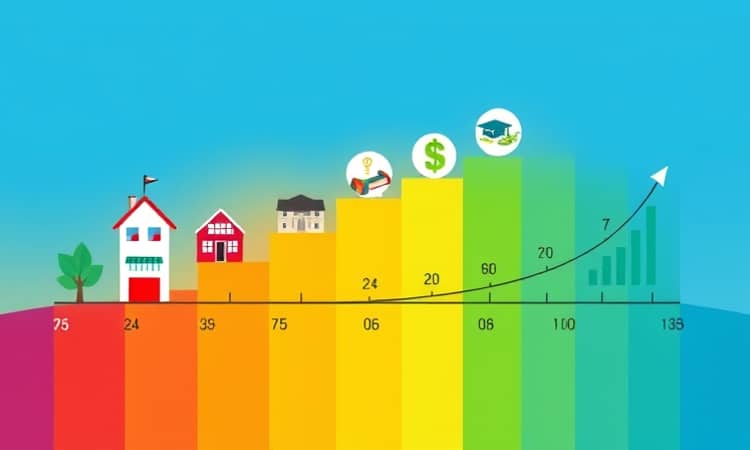
Saving isn’t one-size-fits-all. Across ages and ambitions, a strategic approach helps you build, grow, and protect wealth at every stage of life.
Life-Stage Strategies
Financial priorities evolve with age. By framing savings as a spectrum spanning your 20s, 30s, and 40s, you can align actions to milestones.
- 20s: Building Foundations
• Establish a budget
- 30s: Growth and Expansion
• Diversified portfolio
- 40s: Refinement and Security
• Portfolio rebalance
Financial Freedom and Independence
Beyond traditional retirement, many pursue FIRE (Financial Independence, Retire Early) variants. Define your path—lean, regular, or fat FIRE—by setting clear targets and timelines.
- Pay yourself first: Automate savings transfers as a top priority; start at 1% of income and build toward 25% in two years.
- Practice frugality: Millionaires often choose affordable cars and homes, hunt deals, and view expenses through a long-term lens.
- Open communication: Share goals with family to align expectations and foster support.
- Maintain flexibility: Adjust plans for life events, career shifts, or market changes.
Retirement Savings Benchmarks and Strategies
As you approach retirement, shift focus from growth to income generation and risk mitigation.
Targets often range from 10 to 12 times annual salary. For a $75,000 earner, aim for $750,000–$900,000 by age 65.
Key tactics include: Roth IRA contributions for tax-free income, a balanced mix of equities and bonds, and disciplined portfolio rebalancing. Follow the 4% withdrawal rule to sustain nest-egg longevity.
Diverse income sources—Social Security, annuities, employer pensions—reduce reliance on market returns and optimize tax efficiency.
Emergency and Short-Term Savings
A robust safety net prevents financial setbacks from derailing long-term plans. Start with a $1,000 starter fund, then build to cover 3–6 months of living expenses in an accessible, high-yield account.
Consistent budgeting and automatic transfers ensure this buffer grows without conscious intervention, protecting against income shocks and inflation spikes.
Education and Family Goals
- 529 college plans: Offer tax-advantaged compounding for college, allowing contributions to grow free of federal tax.
- Sandwich generation strategies: Balance eldercare and childcare by prioritizing care responsibilities and exploring multigenerational solutions.
- Scholarships and grants: Augment savings with merit-based or need-based aid to reduce loan reliance.
Debt vs. Savings Prioritization
High-interest debts can erode returns. Focus on paying off credit cards and personal loans while still capturing employer 401(k) matches—this free money accelerates net worth growth.
Maintain healthy credit by monitoring scores, avoiding unnecessary inquiries, and managing utilization ratios below 30%.
Broader Planning Disciplines and Habits
A formal financial plan serves as your roadmap. By tracking net worth, cash flow, and periodic goals, you gain clarity and momentum.
Emotional investing decisions cost money, so stick to long-term strategies during market swings. Regularly review tax policies and retirement legislation—SECURE Act 2.0 enhancements and COLA adjustments can reshape your approach.
Whether you’re in your 20s or your 60s, adopting disciplined habits and personalized milestones lets you navigate the full savings spectrum, turning aspirations into achievable outcomes.