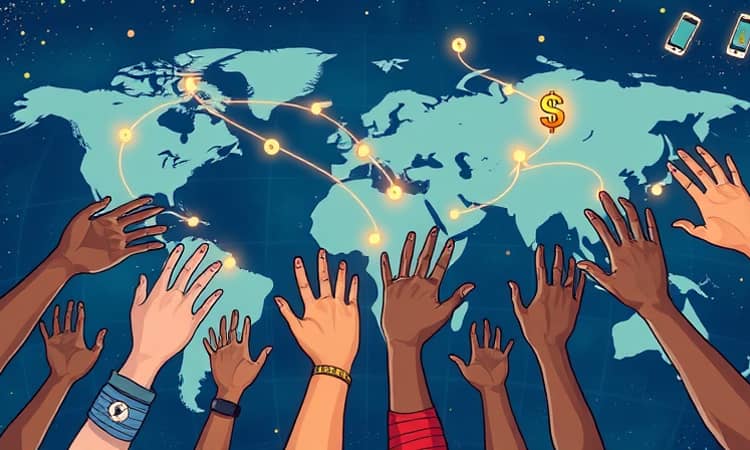
Every day, families and businesses across the globe rely on cross-border money transfers to support loved ones, pay suppliers, and sustain livelihoods. Yet, the reality remains that remittances can take days, incur high costs, and suffer opaque fees. This friction often leaves recipients waiting anxiously, while senders face unpredictable charges.
Imagine a world where funds move as swiftly as an email, where sending support is as simple as clicking a button. By 2026, a new era of remittances will be defined by instant, borderless financial flows, reshaping how money moves and empowering communities everywhere.
From Slow Transfers to Instant Connections
For decades, cross-border payments have been synonymous with lengthy delays and hidden charges. Traditional systems route transactions through multiple intermediaries, each adding time and cost. This often means days of waiting before funds reach family members abroad or suppliers overseas.
Today, more than 70 countries have implemented domestic real-time payment (RTP) schemes, and that number is expected to surpass 80 by 2026. Initiatives like the EU’s Instant Payments Regulation mandate euro transfers within ten seconds, complete with Verification of Payee (VoP) to reduce errors. These advancements are dismantling the barriers that once defined international transfers.
Advancing Interoperability: Building Bridges Across Borders
Interoperability has moved from aspiration to expectation in the payments world. Projects such as BIS Project Nexus and SWIFT’s digital ledger are creating shared corridors that link national RTP systems. Banks, digital wallets, and stablecoin platforms are integrating into unified networks, enabling seamless wallet-to-wallet global transfers without the need for cumbersome pre-funding arrangements.
As these networks expand, the vision of truly borderless payments comes into focus. Consumers and businesses will be able to send or receive funds across continents with the same ease experienced in domestic transactions, eliminating fragmentation and reducing costs.
Harnessing Digital Assets and ISO 20022 for Efficiency
The adoption of stablecoins and tokenized deposits is accelerating, offering instant settlement, real-time liquidity, and transparent, immutable ledger records globally. By removing intermediaries and leveraging blockchain technology, remittances can settle in seconds instead of days, with all parties enjoying clear audit trails.
Concurrently, the shift to ISO 20022 messaging by November 2026 will standardize data formats across financial institutions. This structured approach facilitates richer remittance details, higher straight-through processing rates, and improved AI-driven fraud detection.
Wallets and Embedded Finance: Empowering End Users
In emerging markets, mobile wallets have become the primary gateway to financial services. By connecting these wallets to global payment rails, users can access international corridors directly from their smartphones.
Whether through QR codes, alias-based addresses, or integrated stablecoin support, wallets are unlocking new pathways for global financial inclusion for everyone. These interfaces simplify the process, ensuring that individuals without traditional bank accounts can participate fully in the global economy.
Regulatory Evolution and AI-Powered Compliance
Regulators worldwide are collaborating to harmonize frameworks that support faster, safer payments. The G20 has set targets for low-cost, efficient cross-border flows, while bodies like the Financial Stability Board monitor risks.
At the same time, financial institutions are deploying AI-powered screening tools to meet anti-money laundering and sanctions requirements in real time. This reduced compliance friction and risk aligns perfectly with the speed of modern remittance platforms, ensuring both security and efficiency.
The Human Impact: Stories and Aspirations
Consider Ana, who sends money monthly to her elderly parents in a rural village. What once required her to start transfers days in advance now arrives in seconds, allowing her to respond instantly to urgent needs. Across the globe, entrepreneurs pay suppliers without worrying about weekend delays, and students access tuition funds just in time for deadlines.
- Families stay connected with instant support for health and education.
- Gig workers receive wages daily, enhancing financial stability.
- Small businesses manage cash flow with real-time liquidity tools.
- Corporations leverage tokenized deposits for efficient treasury operations.
Charting the Path Forward
The transition to next-gen remittances demands strategic collaboration among banks, fintech firms, regulators, and technology providers. By embracing innovation today, stakeholders can build the infrastructure that will define the future of cross-border payments.
- Invest in RTP linkages and cross-border corridor expansion.
- Adopt ISO 20022 standards and enhance data interoperability.
- Integrate stablecoins and tokenized assets for instant settlement.
- Form technology partnerships to reduce intermediaries.
- Educate end users on secure, efficient digital payment methods.
The next chapter in money movement is within reach. By fostering global collaboration and inclusive innovation, we can realize a world where sending and receiving money is as natural as sending a message. Together, we will rewrite the narrative of remittances, unlocking prosperity and opportunity for everyone.