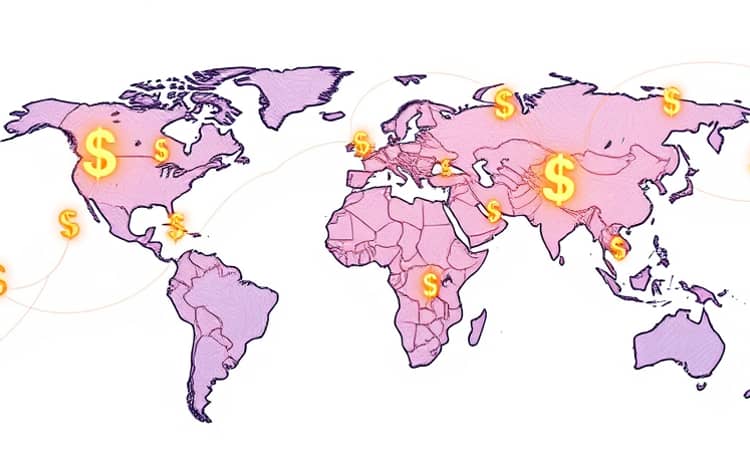
In our interconnected world, the silent movement of capital across borders weaves a tapestry of economic interdependence. This global capital circuit dictates fortunes, from stock market surges to job creation in distant lands.
Understanding these flows is not merely an academic exercise; it is a tool for empowerment in an increasingly financialized era. Tracking money movements reveals hidden patterns that can guide strategic decisions and foster resilience.
By delving into the capital circuit, we uncover the pulse of global finance, where money transforms and circulates endlessly. This knowledge opens doors to opportunities in investing, development, and policy-making.
The Foundation: Balance of Payments
The balance of payments serves as the global ledger, recording all economic transactions between countries. It always balances, meaning deficits in one account must be offset by surpluses in another.
This identity is expressed as: Current Account + Capital Account + Financial Account + Changes in Reserves = 0. Net capital inflows finance deficits, enabling countries to sustain trade imbalances.
Here are the key components that make up this framework:
- Current Account: Covers trade in goods and services, income from investments, and transfer payments like remittances.
- Capital and Financial Account: Includes investments such as foreign direct investment and portfolio flows, which drive cross-border money movements.
- Official Reserves: Central bank holdings of foreign currencies used to stabilize exchange rates and manage economic shocks.
Grasping this framework is essential for anyone tracking global finance. Gross flows vastly exceed net flows, highlighting the sheer volume of transactions that define modern economies.
The Marxist Circuit of Capital
Karl Marx's analysis provides a deeper lens on capital's relentless journey through production and realization. He described it as M—C...P...C'—M', where money transforms into commodities, undergoes production, and emerges as augmented money.
In this process, surplus value is created and realized, fueling reinvestment in a cycle that drives economic expansion. This circuit repeats endlessly, shaping growth and accumulation on a global scale.
Modern applications extend this to three interconnected circuits that define capital's flow:
- Money Capital Circuit: Funds are invested in productive assets, seeking profit through strategic allocation.
- Productive Capital Circuit: Labor and materials combine to produce goods, where value is added through human effort.
- Commodity Capital Circuit: Finished products are sold, converting back to money and completing the cycle of realization.
This cyclical nature underscores capital's inherent drive for growth. Globalization has expanded these circuits across borders, integrating markets and creating complex financial networks.
Composition of Global Capital Flows
Capital flows come in various forms, each with distinct characteristics that influence economic outcomes. Direct investment offers long-term stability, while portfolio flows can introduce volatility into markets.
The following table summarizes the main types of capital flows, based on historical data and theoretical insights:
Understanding this diversity is crucial for assessing financial health. FDI is prioritized for development due to its ability to spur infrastructure and job creation, making it a key focus for policymakers.
Drivers of Capital Flows
What motivates money to cross borders in search of new horizons? Several theories offer insights into the forces behind these movements. Return differentials attract investment to regions with high growth potential, often in developing economies.
Key drivers that shape global money flows include:
- Neoclassical Perspective: Capital flows from areas with low returns to those with high returns, driven by scarcity and opportunity in global markets.
- Monetary Circuit Theory: Banks create credit that channels funds internationally, emphasizing finance motives for production over mere speculation.
- Supply and Demand in Equity Markets: Investor sentiment and economic conditions influence how money tracks and allocates resources, affecting flow patterns.
Recognizing these drivers helps predict and manage flow dynamics. Cyclical surges can lead to crises, as evidenced by emerging market booms and busts in the 1990s, urging caution in financial planning.
Historical Patterns and Data Insights
Tracking capital flows over time reveals evolving trends that shape our economic landscape. Gross financial transactions have skyrocketed in recent decades, far exceeding net flows and underscoring global integration.
From 1996 to 2001, world trade totaled $17.3 trillion, while financial flows reached $5.0 trillion, showing how finance complements trade. Industrial countries dominate these movements, but developing nations are steadily increasing their share.
Notable shifts in global patterns include:
- In 2003, industrial countries accounted for 84% of gross flows, though this has declined from 90% in 1998, indicating a redistribution of financial power.
- Developing countries, led by East Asian economies like China, have risen in prominence, with China and Hong Kong representing 28% of LDC flows by 2003.
- The US runs persistent current account deficits, financed by net inflows from other nations, highlighting its role as a global financial hub that absorbs capital.
These patterns remind us of finance's dynamic nature. Data sources like the IMF provide essential tools for analysis, enabling better tracking and forecasting of money movements.
Implications for Development and Risk Management
For developing countries, capital flows present both golden opportunities and significant perils. Long-term FDI fosters sustainable growth by building local capacities and creating stable employment opportunities.
Key considerations for leveraging flows include:
- Prioritizing FDI: Encouraging direct investment can enhance infrastructure and technological transfer, driving holistic economic development.
- Managing Volatility: Implementing capital controls or macroprudential policies can mitigate boom-bust cycles, protecting economies from sudden outflows.
- Learning from Crises: Historical events like the Asian Financial Crisis underscore the risks of uncontrolled inflows, urging proactive risk assessment.
By tracking flows diligently, policymakers can design strategies that balance growth with stability. Global financial crises have reshaped consensus, emphasizing the need for prudent financial governance in an interconnected world.
Practical Insights for Modern Engagement
How can individuals and organizations harness the power of the capital circuit in today's world? Investors can identify emerging markets with strong FDI inflows, signaling untapped growth potential for savvy allocations.
Businesses can leverage flow data to enhance their global strategies through:
- Assessing currency risks based on reserve movements and trade balances, enabling better hedging and planning.
- Planning international expansions by targeting regions with favorable investment climates and stable capital inflows.
- Navigating regulatory environments by understanding capital control policies and their impacts on cross-border transactions.
For citizens, this knowledge demystifies the forces shaping economies. Empowerment comes from awareness of how money flows influence local communities and global trends, fostering informed participation.
Embracing the Flow: A Path Forward
The capital circuit is more than an abstract concept; it is a living, breathing force that animates our global economy. Tracking global money flows reveals opportunities for innovation, collaboration, and resilience in an ever-changing world.
By mastering this framework, we can contribute to a more stable and prosperous future. The journey of capital continues, inviting us all to participate wisely, ethically, and with a vision for shared growth.
Let this understanding guide your decisions, whether in investment, policy, or personal finance, turning insight into action for a better tomorrow.