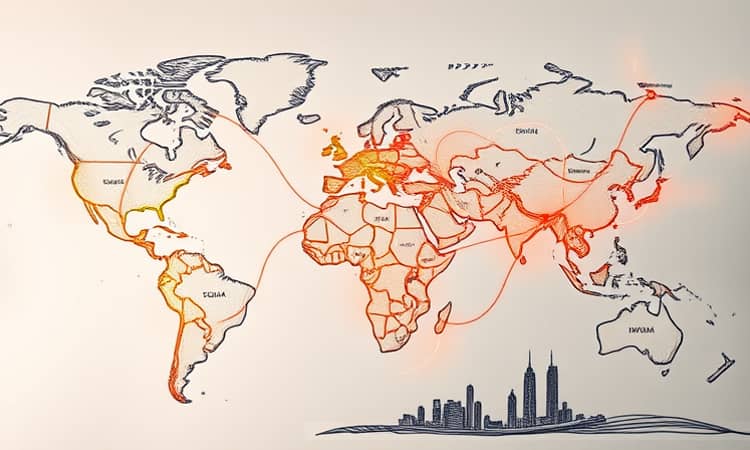
In 2026’s volatile landscape, bold strategies and an adaptive mindset unlock new horizons, guiding businesses toward sustainable global growth.
Economic Context and Opportunity
The global economy in 2026 is a tapestry of shifting markets, alternating between robust growth in emerging regions and cautious readjustment in established economies. Over 60% of global GDP growth will emanate from cross-border markets, underscoring why timely entry is critical to maintain competitive advantage.
Core inflation has stabilized around 4.5% for global markets, prompting businesses to recalibrate pricing models and supply chains. Advertising budgets are set to grow by 9.5% in 2026, with AI-driven campaigns leading the charge. Meanwhile, 58% of business leaders plan to launch new offerings, and strategic partnerships are pursued by nearly half of executives worldwide.
Global productivity remains flat, with 40% of large enterprises experiencing negative growth while top performers achieve up to 8% annual gains. This contrast highlights the power of transformative operations and technology adoption.
This confluence of economic signals offers an unprecedented window of opportunity for ambitious brands, from startups to Fortune 500 enterprises, to diversify revenue, mitigate risks, and build resilience against geopolitical headwinds.
A Phased Blueprint for Market Expansion
A successful expansion is not a leap, but a series of calculated steps. The following framework outlines a clear path from initial assessment to full-scale deployment:
- Conduct in-depth market research to validate demand, analyze competitors, and navigate local regulations.
- Implement phased entry, piloting in one or two priority markets to refine offerings before broad rollout.
- Forge strategic partnerships and alliances to accelerate entry, leveraging local distribution networks.
- Localize products, pricing, and marketing with cultural nuance for deeper customer engagement.
- Utilize scenario-based planning to anticipate tariff changes, supply disruptions, and currency fluctuations.
- Integrate AI-driven forecasting for hyperlocal demand sensing and agile decision making.
Beyond these core tactics, advanced levers accelerate momentum. Establish dual-track supply chains—global and regional—for resilience. Balance organic initiatives with targeted M&A to gain speed in competitive markets. Cultivate a “glocal” mindset: strict global guardrails paired with local experimentation ensure rapid iteration and knowledge sharing.
By embracing this data-driven strategy amid volatility, organizations reduce risk and build a foundation for scalable success.
Marketing Trends Driving Expansion
Marketing plays a pivotal role in bringing the expansion blueprint to life. Key trends are reshaping how brands connect with new audiences:
- AI-driven personalization balanced with authentic human engagement.
- Divided focus on visual and audio content, now a top strategy for 22% of marketers.
- Voice search optimization as 73.7% of companies ramp up investment.
- Unified measurement models that respect privacy while delivering actionable insights.
- Channel ecosystems integrating affiliate, paid, social, email, and direct mail.
Search strategies are rapidly evolving: 24% of teams explore generative AI in search, while 41% update SEO for algorithm shifts. Brands that master voice and AI-enhanced discovery will outpace competitors in new territories.
Hyper-personalized campaigns—triggered direct mail, dynamic social ads, localized content hubs—forge stronger emotional bonds. This balanced blend of automation and human touch drives retention and turns customers into brand advocates.
Case Studies in Action
Consider a Southeast Asian technology firm that harnessed AI-driven forecasting to tailor pricing and promotions across multiple countries. Within 18 months, operations costs shrank by 15% and revenue surged by 10%, thanks to hyperlocal data insights and empowered regional teams.
In Sub-Saharan Africa, a consumer goods startup formed strategic alliances, accelerating market penetration by 35%. By co-developing distribution channels with established partners, the startup leapfrogged regulatory hurdles and tapped into underserved communities, achieving 30% higher retention rates within one year.
An education technology brand launched localized digital classrooms in Latin America, partnering with local educators to co-create curricula. This approach delivered a 40% increase in user adoption and positioned the brand as a trusted regional partner.
Assessing Risks and Readiness
No expansion is without potential pitfalls. Common missteps include overreliance on static forecasts, ignoring changing trade policies, and underestimating cultural nuances. To safeguard growth:
- Stress-test business models against various geopolitical and economic scenarios.
- Maintain regionalized supply chains with dual global and local tracks.
- Implement structured readiness assessments covering legal, tax, and operational factors.
Regular scenario reviews—monthly or quarterly—equip teams to pivot swiftly. Embedding flexible governance and rapid-feedback loops creates resilient operational frameworks capable of withstanding unexpected shocks.
Industry and Regional Insights
Different sectors and geographies offer unique advantages and considerations. A quick overview:
Sub-Saharan Africa, projected to grow at 4.2% in 2026, rewards cautious yet bold entry strategies. Southeast Asia’s dynamic markets favor businesses that combine rapid experimentation with local expertise to seize growth waves.
Conclusion: Embracing Growth with Resilience
Charting new markets demands a synthesis of strategic foresight, localized agility, and technological innovation. By following this blueprint—grounded in rigorous research, phased execution, and adaptive marketing—business leaders can unlock sustainable growth while navigating uncertainty.
Ultimately, expansion is a journey of continuous learning and reinvention. Organizations that invest in robust scenarios, foster partnerships, and embrace augmented learning through AI will emerge not only unscathed but stronger, poised to define the next era of global success.