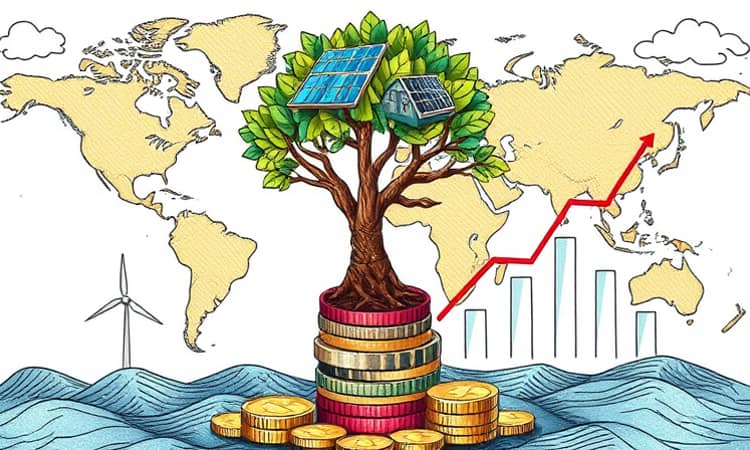
The financial landscape is shifting towards a future where profit and purpose intertwine seamlessly.
Sustainable investing is no longer a fringe concept but a core component of modern portfolios.
With assets under management reaching impressive scales, this movement promises tangible benefits for both investors and the planet.
This article explores the growth, drivers, and practical strategies to help you navigate this dynamic field.
From market statistics to emerging trends, we provide insights to inspire and guide your investment journey towards a greener tomorrow.
The Expanding Market of Sustainable Investing
US sustainable assets under management are projected to hit $6.6 trillion in 2025.
This represents about 11% of the total US market AUM, which stands at approximately $61.7 trillion.
Globally, sustainable fund assets climbed to $3.7 trillion by Q3 2025, driven by steady inflows and market appreciation.
Investor interest remains strong, with 86% of asset owners planning increased allocations in the next two years.
This growth underscores a significant shift in how capital is deployed for positive impact.
- US sustainable AUM: $6.6 trillion in 2025, up from $6.5 trillion in 2024.
- Global sustainable fund assets: $3.7 trillion by Q3 2025, with Q2 net inflows of $4.9 billion globally.
- Investor expectations: 53% of individuals predict sustainable market growth next year.
- Active stewardship policies cover 69% of US market AUM, or $42.7 trillion.
These figures highlight a resilient market adapting to broader economic changes.
Key Drivers Fueling Sustainable Investments
Climate change is the top issue, cited by 52% of investors as a key driver.
Other factors include client customization, catastrophic events, and biodiversity loss.
Emerging themes like AI and Indigenous Peoples' rights are gaining traction, with 23% seeing AI's positive impact.
The political environment shows that 62% of investors remain unaffected by backlash.
Instead, many focus on financial materiality to drive decisions.
- Top drivers: Climate change (52%), client customization (41%), catastrophic events (38%).
- Emerging themes: AI (23% positive impact), biodiversity loss (34%).
- Political response: 29% focus on financial materiality, 25% dropped the "ESG" acronym.
This pragmatic approach ensures that sustainability efforts align with long-term value creation.
Popular Strategies for Effective Investing
ESG integration is mainstream, used by 77% of investors, with 38% expecting growth.
Impact investing and sustainability-themed strategies are also on the rise, with 46% and 43% anticipating expansion, respectively.
Decarbonisation efforts, including Net Zero frameworks, are critical but face challenges.
Only less than 3% of companies are net-zero aligned, highlighting the need for accelerated action.
Stewardship and engagement dominate, covering most assets under management.
- ESG integration: 77% usage rate.
- Expected growth: Impact investing (46%), sustainability-themed (43%).
- Decarbonisation: Focus on low-carbon opportunities in equities and fixed income.
- Stewardship: Policies cover a majority of AUM for active oversight.
Adopting these strategies can help investors mitigate risks and seize opportunities.
High-Priority Sectors and Investment Opportunities
Investor allocations are highest in energy (86%), innovation (76%), and transport (72%).
Renewables and the energy transition are soaring, with global investments set to rise in 2026.
Green bonds are a standout, with US sales near record levels at $550 billion by November 2024.
Globally, labeled sustainable bonds reached around $1 trillion in 2025, including $620 billion in green bonds.
Climate and nature solutions, such as clean energy and sustainable agriculture, offer measurable outcomes.
- Top sectors: Energy, innovation, transport.
- Green bonds: US sales of $550 billion, global green bonds at $620 billion in 2025.
- Biodiversity: Bonds increased from 5% to 16% of green issuances from 2020 to 2023.
- Examples: Ecuador's $1.6 billion debt-for-nature swap, Goldman Sachs' $500 million fund.
These sectors provide concrete avenues for aligning investments with environmental goals.
Regional Perspectives on Sustainable Investing
This table illustrates how different regions are adapting to sustainable investing trends.
Each area brings unique strengths and challenges to the global movement.
Navigating Challenges and the Political Context
Headwinds include ESG backlash, policy shifts, and greenwashing scrutiny.
However, responses show pragmatism and resilience, with 46% of investors unaffected by politics.
Data gaps, such as credible emissions targets, remain a hurdle, with less than 3% of companies net-zero aligned.
Investors are focusing on tangible outcomes to overcome these obstacles.
- Challenges: ESG backlash, regulatory setbacks, data gaps.
- Responses: Drop ESG label (25%), focus on financial materiality (29%), no retreat (46% unaffected).
- Data issues: Need for better emissions targets and transition plans.
Addressing these issues is crucial for sustained progress in sustainable finance.
Emerging Trends for 2026 and Beyond
The future points towards a recalibration towards realism and pragmatism.
Demonstrating tangible value and innovation will be key to growth opportunities.
Climate focus will intensify on transition and adaptation, with private markets playing a larger role in infrastructure.
Bonds are evolving with new standards in green, social, and sustainability-linked instruments.
Tech intersections, like AI risks and opportunities, will shape digital resilience.
Social and environmental data demand is rising, especially from US investors.
Surveys indicate younger investors have the strongest interest, ensuring long-term commitments.
- Trends: Recalibration, climate focus, bonds evolution, tech intersections.
- Data: Increased demand for biodiversity and nature solutions data.
- Investor base: Sustained commitments from pensions, insurers, and sovereign wealth funds.
Embracing these trends can help investors stay ahead in a rapidly changing market.
As Maria Lettini, US SIF CEO, notes, there is "no retreat from sustainable investing," only pragmatic adaptation.
Anthony Eames of Calvert Research emphasizes that ESG integration is fundamental to strengthening markets.
Morningstar highlights the tangible value of sustainability in driving innovation.
This collective wisdom reinforces that sustainable investing is a strategic imperative for a resilient future.
By leveraging these insights, you can make informed choices that benefit both your portfolio and the planet.
Start your journey today towards a greener, more prosperous tomorrow.