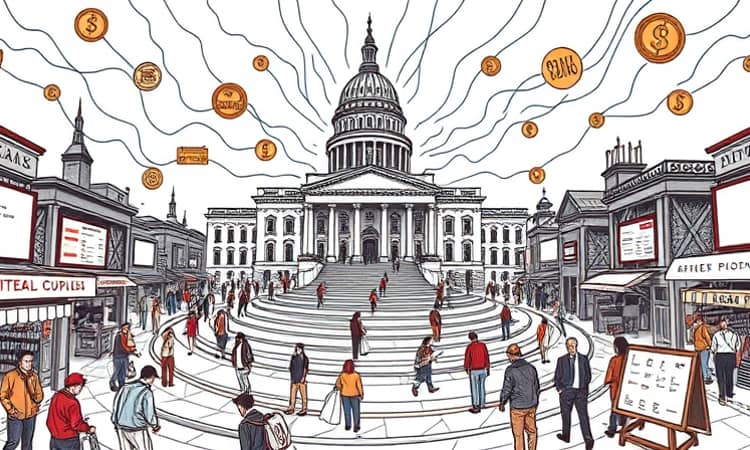
Government interventions often set off supply-demand dynamics and investment incentives that reshape markets in unforeseen ways. By adjusting taxes, subsidies, or regulatory frameworks, policymakers aim to direct behavior toward social goals while maintaining economic vitality. However, each action sparks reverberations across sectors, from consumer habits to corporate strategies and broader growth trajectories. Understanding these pathways is crucial for designing long-term coherent policy strategies that harness positive change and mitigate risks.
Mechanisms of Policy Impact
At the core of policy aftershocks are several distinct mechanisms that govern how decisions translate into market outcomes. Key tools include fiscal levers, monetary measures, regulatory mandates, and targeted incentives, each interacting with the elasticity of goods and services to determine the magnitude of change.
- Taxes and Subsidies on PED: Taxes raise consumer prices, reducing demand based on elasticity. Inelastic goods like cigarettes see minimal consumption drop on a 15% price hike, yielding only a 5% demand fall while generating significant revenue.
- Price Controls Affect Market Balance: Minimum wages or rent ceilings disrupt equilibrium, creating surpluses when supply is elastic or shortages when demand is inelastic, with consequences that vary by sector.
- Fiscal and Monetary Measures: Public spending on infrastructure, education, and healthcare creates jobs and boosts productivity, while central banks adjust interest rates and money supply to stimulate investment or tame inflation.
- Regulatory Frameworks and ESG Disclosure: New requirements like the EU’s sustainability rules and U.S. lending mandates enhance transparency, promote fair competition, and channel capital toward responsible enterprises.
- Public Investment in Infrastructure: Massive projects—roads, schools, hospitals—drive productivity gains and long-term returns, as Mexico’s $68 million Programa Hábitat demonstrates with lasting wage and firm revenue growth.
- Trade and Industrial Policies: Sector-specific support for clean energy or manufacturing boosts exports and foreign investment, though misaligned incentives can lead to inefficiency and dependency.
Real-World Case Studies
A classic example of tax policy on an inelastic good is cigarette taxation. When governments impose a 15% levy on packs priced around $2, demand falls only about 5%, illustrating the inelastic nature of certain consumer goods. This measure raises revenue effectively without sharply reducing consumption, funding public health campaigns or general spending.
The Low-Income Housing Tax Credit (LIHTC), introduced in 1986, channels private capital into affordable housing. By offering credits for investments in central city and low-income communities, LIHTC has financed thousands of units for families, elderly, and disabled residents through syndicators and direct placements. Despite regional implementation challenges, it remains a cornerstone of impact-driven real estate investment.
The 2022 Inflation Reduction Act (IRA) sets aggressive environmental goals, aiming to triple greenhouse gas cuts by 2030. Paired with IRS technology upgrades, the act streamlines tax benefits for clean energy projects, emphasizing the role of fiscal incentives in climate strategy.
Social Impact Bonds (SIBs) represent another frontier in policy innovation. In New York City’s 2012 initiative at Rikers Island, Goldman Sachs and Bloomberg Philanthropies targeted recidivism reduction: achieving a 9% drop versus control led to $20 million in city savings. In the UK, Peterborough’s SIB structure offers investors a 3% annual return for meeting rehabilitation targets, a success hailed by the Ministry of Justice.
Key SIB examples at a glance:
Navigating Elasticity and Outcomes
Understanding price elasticity of demand is critical for anticipating policy impact. When goods are inelastic, tax hikes translate into reliable revenue streams with modest behavior change. Conversely, highly elastic products respond dramatically to price shifts, making subsidies a potent tool for driving consumption in areas like renewable energy.
Misjudging elasticity can produce unintended market distortions. Overestimating consumer responsiveness leads to revenue shortfalls, while underestimating may leave social objectives unmet. Policymakers must analyze consumer and producer responsiveness using data and rigorous modeling to calibrate measures effectively.
Success Stories and Cautionary Tales
Some initiatives have yielded transformative outcomes. Mexico’s Programa Hábitat invested $68 million across 370 neighborhoods, spurring lasting wage hikes and firm revenue growth. The program became self-financing through increased tax receipts within 14 years, showcasing self-sustaining large-scale infrastructure investment.
However, risks abound. The SEC’s 2022 $4 million fine against Goldman Sachs for ESG misstatements highlights the pitfalls of inconsistent disclosure. Overregulation can stifle innovation, and fragmented policies undermine business planning. Achieving balance requires coordinated policy review processes and adaptive governance.
Key takeaways from these examples include:
- Mexico’s program achieved payback through tax growth
- IRA drives climate action with fiscal tools
- ESG misstatements lead to regulatory penalties
- Elasticity errors risk revenue and behavior goals
Broader Economic Ripples
Policy aftershocks extend beyond targeted sectors, influencing global equity prices, interest rate cycles, and corporate strategies. Central bank rate hikes to combat inflation can tighten liquidity, altering investment flows. Meanwhile, companies pivot toward ESG and impact-oriented models, seeking stable returns paired with social benefits.
At the community level, tax credits and infrastructure schemes create jobs, enhance housing affordability, and reduce emissions. Yet inconsistent or short-lived measures breed uncertainty, deterring long-term capital allocation. Policymakers should prioritize balanced experimentation and rigorous evaluation to refine approaches and foster resilience.
By weaving together fiscal, monetary, and regulatory threads, government decisions shape the economic tapestry in profound ways. Embracing data-driven design, stakeholder engagement, and transparent governance can help align market incentives with public welfare, ensuring that policy pathways generate enduring economic vitality.