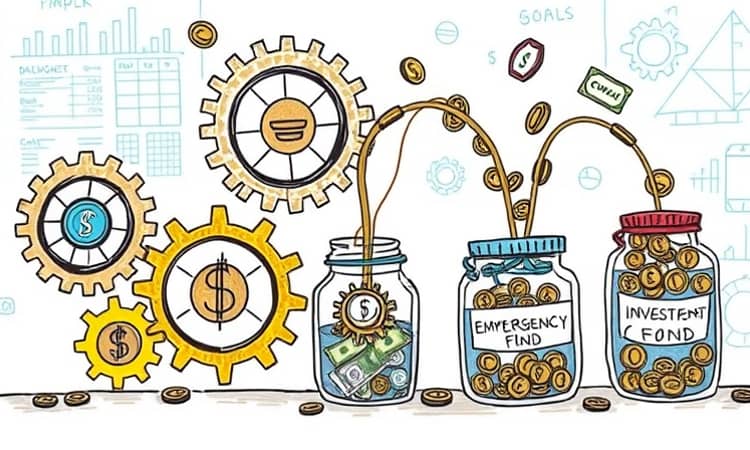
Just as engineers design bridges and machines, you can design a powerful financial system that supports every stage of your life. By understanding cashflow mechanics and applying disciplined habits, you can turn money into a reliable ally.
Living Below Your Income: The Solid Foundation
Every great structure starts with a strong base. In personal finance, that base is tracking your take-home cash. Allocate funds for essentials first—housing, utilities, groceries, debt payments—and identify the unallocated surplus. That surplus becomes the seed for emergencies, retirement, or life’s pleasures.
Personal Cash Forecasting: Aligning Income and Priorities
Personal cash forecasting is the core mechanic that ties income to goals. By modeling your cashflow each pay period, you gain clarity and control.
- List annual goals and divide into monthly targets.
- Deposit net pay into checking; subtract two-week spending.
- Transfer 60-day needs to savings; move longer-term funds to investments.
- Calculate: beginning balance + allocation – spending = ending balance.
- Direct any surplus into an unallocated category for future use.
Budgeting and Cash Flow Management
True budgeting reflects real life. Start by categorizing expenses: essentials, obligations, discretionary wants. Use a monthly cash allocation chart to visualize where your dollars go.
- Track spending across checking, credit, and digital wallets.
- Prioritize essentials; then cap discretionary categories.
- Review and adjust for patterns like dining out or streaming services.
- Avoid overly strict limits; focus on sustainable patterns.
Goal Setting and Forecasting
Write clear, measurable goals: retirement contributions, debt payoff, home purchase, vacations. Divide them into monthly or semi-monthly savings targets—save $200 each month makes progress concrete. Regularly update forecasts to stay on track.
Automation and Habits
Automation is the secret weapon in your finance toolkit. Set up automatic payments for debts and transfers to high-yield savings or money market accounts. Schedule a monthly review to cancel unused subscriptions and refine your plan.
Savings and Emergency Funds
Build an emergency cushion equal to three to six months of living expenses in a liquid account. Consider money market mutual funds for stability and easy access. Use a separate account for mid-term needs (60 days) and channel longer-term savings into investment vehicles.
By build three to six months you insulate yourself from life’s unexpected storms.
Debt Management
High-interest debt can erode your financial health. Prioritize paying down credit cards and other costly lines of credit. Reserve term loans only for homes, education, or business ventures. Use a debt snowball or avalanche approach—small sacrifices like reduced dining out quickly accelerate progress.
Investing and Retirement
Maximize employer matches in your 401(k) and IRA. Allocate assets according to your time horizon and risk tolerance. In the current environment, consider short-term fixed income with five to seven year maturities, anticipating roughly 100 basis points of rate cuts over the next year.
align investments with goals to ensure every dollar works toward your future dreams.
Credit Mechanics and Cash Transfers
Understand the difference between term loans and lines of credit. Deposit your take-home pay into checking, then transfer excess funds every pay period—a quick 20-minute task—to savings and investment accounts. This disciplined cycle fosters consistency and growth.
Review and Adjustment Cycles
Your financial plan must evolve with changing markets and life events. Conduct annual reviews of budgets, investments, and tax strategies. Prepare for year-end and year-start with a defined checklist:
- Review recent statements and spending trends.
- Reevaluate goals: savings, debt reduction, retirement contributions.
- Automate new transfers and payments.
- Top up emergency reserves; confirm 401(k) match rates.
- Adjust portfolios for inflation resilience and market volatility.
Understanding Money Creation
Beyond your personal cash, banks employ fractional reserve banking to expand the money supply. With a 10% reserve requirement, a $10,000 deposit yields $9,000 in excess reserves for lending. Loans become assets, deposits become liabilities, and both grow—illustrating the broader mechanics of money.
banks create money through lending, a process that shapes global credit availability and interest rates.
Putting It All Together: Your Financial Blueprint
By engineering your finances through disciplined forecasting, strategic budgeting, and thoughtful automation, you build a system that grows with you. Embrace these money mechanics, and transform uncertainty into confidence, one calculated step at a time.