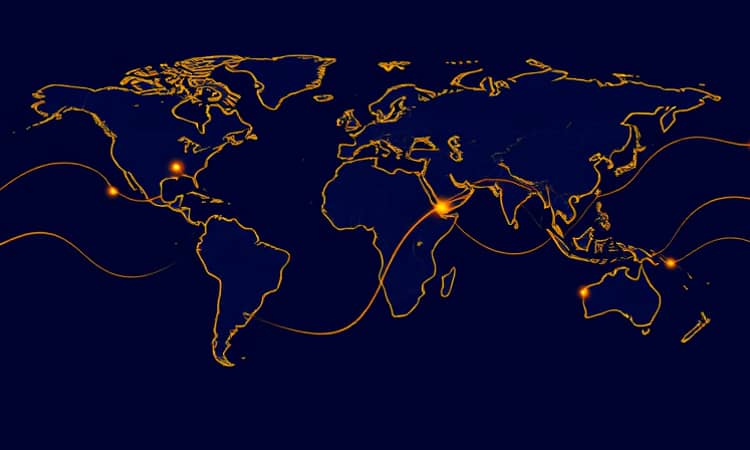
In today's interconnected world, understanding global capital flows is more critical than ever for investors, policymakers, and businesses alike.
The movement of money across borders shapes economies, drives growth, and signals shifting opportunities in an ever-evolving financial landscape.
From the surge of investments into emerging markets to the subtle shifts in developed economies, these flows offer a real-time pulse on global economic health.
As we navigate a post-pandemic era marked by volatility and transformation, tracking these trends can unlock insights for strategic decision-making and resilience.
The Anatomy of Global Capital Flows
Global capital flows encompass a complex web of financial movements that define international investment.
At their core, they include non-resident inflows such as foreign direct investment (FDI), portfolio equity, and debt, along with resident outflows where domestic entities acquire foreign assets.
The balance between these elements, known as net capital flows, is a key indicator, especially for emerging markets (EMs) where data from the Balance of Payments (BOP) provides crucial insights.
Decoupling trends have emerged prominently, with China experiencing weakening inflows post-COVID-19 while other EMs see stronger engagement.
This divergence highlights the nuanced dynamics at play, driven by factors like geopolitical shifts and economic policies.
- Key components: FDI, portfolio investments, other financial flows.
- Tracking tools: BOP data, IMF monitors, and real-time trackers.
- Importance for EMs: Indicators of stability and growth potential.
Understanding this structure is the first step toward navigating the global investment maze effectively.
Recent Trends: A Volatile Landscape
The period from 2024 to 2025 has been characterized by significant turbulence in capital flows, with emerging markets facing particular challenges.
In late 2024, EMs witnessed their first net capital outflows since early 2020, driven by a sharp decline in non-resident inflows and rising resident outflows.
Provisional data for early 2025 shows continued portfolio outflows in equities and bonds, though with some modest recovery in bond inflows by March.
FDI has stabilized but remains low, contrasting with the volatility in portfolio movements, underscoring a shift toward more cautious investment strategies.
This table summarizes recent trends in EM non-resident portfolio and FDI flows as a percentage of GDP, based on median values:
The data reveals a clear pattern of increasing volatility and regional disparities, with Asia experiencing outflows while Latin America shows signs of FDI recovery.
- Trailing 12-month flows: Equity outflows worsened, debt inflows moderated, and nominal FDI rebounded, led by Latin America.
- China-specific trends: Inflows moderated in Q4 2024, with debt and equity outflows, while resident outflows increased.
- Global FDI: Fell 11% to $1.5 trillion in 2024, marking a second straight decline, reflecting broader economic uncertainties.
These trends underscore the need for adaptive strategies in a rapidly changing environment.
Emerging Markets: Divergence and Resilience
Emerging markets are at the forefront of capital flow dynamics, showcasing both vulnerability and resilience in the face of global headwinds.
The decoupling of China from other EMs post-COVID-19 is a standout theme, with weakening inflows to China contrasting with stronger flows elsewhere, as highlighted by Brookings data showing FDI decoupling downward.
This shift has been exacerbated by factors such as the RMB devaluation and geopolitical tensions, which have spurred capital flight in some regions.
Meanwhile, other EMs have seen robust inflows, driven by factors like higher growth rates and strategic policy adjustments.
For instance, trailing 12-month flows for EM ex-China show equity outflows worsening but debt inflows moderating, with FDI on a rebound path led by Latin America.
- Key drivers: Post-COVID recovery, regional economic policies, and investor sentiment shifts.
- Resident outflows: Moderating in early 2025 after rising in late 2024, indicating a balancing act in capital mobility.
- Impact on growth: EM growth remains above 4%, offering a buffer against flow volatility and attracting opportunistic investments.
Understanding these divergences can help investors identify pockets of opportunity and risk in the EM landscape.
Regional Insights: From Asia to Latin America
Capital flows are not uniform across regions, with distinct patterns emerging that highlight local economic strengths and challenges.
In Asia, EMs like India, Malaysia, and Thailand faced outflows in Q4 2024, ending a streak of inflows and signaling increased caution among investors due to factors like tightening financial conditions.
Conversely, regions like Europe and Latin America have seen inflows, with countries such as Poland, Türkiye, Chile, and the Philippines attracting capital, particularly in FDI.
Latin America, in particular, is leading the FDI recovery, demonstrating resilience and strategic appeal in sectors like resources and technology.
This regional variation is further illustrated by heat maps from the IMF, showing percentile ranks for non-resident flows, with some areas outperforming historical averages while others lag.
- Asia highlights: Outflows driven by economic slowdowns and policy uncertainties.
- Europe/LATAM successes: Inflows bolstered by stable governance and growth prospects.
- US-Europe flows: Bidirectional movements influenced by equity performance, with significant shifts in recent years.
By zooming in on these regional nuances, stakeholders can tailor their approaches to capitalize on local dynamics.
Drivers and Catalysts Shaping Flows
Several key factors are driving the ebb and flow of global capital, from macroeconomic conditions to geopolitical events.
Tightening financial conditions in early 2025, for example, have contributed to portfolio outflows from EMs, while post-COVID shifts and potential policy changes under new administrations add layers of complexity.
Events like the Ukraine war and tariff implementations have also played a role, though they have not significantly dented EM growth projections, which remain upwardly revised for 2025.
External financing mixes vary, with some regions relying more on FDI versus portfolio investments, and remittances proving to be a strong, stable source of capital in many EMs.
Data sources such as the IMF BOP monitor, Haver Analytics, and TIC reports provide the backbone for tracking these drivers, offering a comprehensive view for analysis.
- Major catalysts: Economic slowdowns, geopolitical tensions, and monetary policy adjustments.
- Impact on projections: EM capital flows are expected to rise significantly in 2025, with benign conditions possible in 2026 if trends stabilize.
- Role of data: Reliable sources enable informed decision-making and trend anticipation.
Recognizing these drivers empowers investors to navigate uncertainties with greater confidence and foresight.
Future Outlook and Practical Guidance
Looking ahead, the trajectory of global capital flows holds both challenges and opportunities, requiring a proactive and informed approach.
Projections suggest that EM capital flows could increase significantly in 2025, driven by resilient growth and adaptive policies, with potential for more stable conditions in 2026 if global economic headwinds ease.
However, risks remain, including persistent volatility in portfolio flows and regional disparities that could exacerbate inequalities.
For investors and businesses, practical steps can enhance resilience, such as diversifying portfolios across regions and asset classes, and staying updated on real-time data from sources like the IIF tracker and UNCTAD reports.
Embracing a long-term perspective, while remaining agile to short-term shifts, can turn capital flow tracking from a mere observation into a strategic advantage.
- Actionable strategies: Monitor regional trends, leverage data analytics, and engage in risk management.
- Inspiration for stakeholders: View flows as indicators of innovation and growth, not just financial metrics.
- Final thought: In a world of constant change, understanding capital flows is key to unlocking global opportunities and fostering sustainable development.
By integrating these insights, individuals and organizations can contribute to a more stable and prosperous global economy.