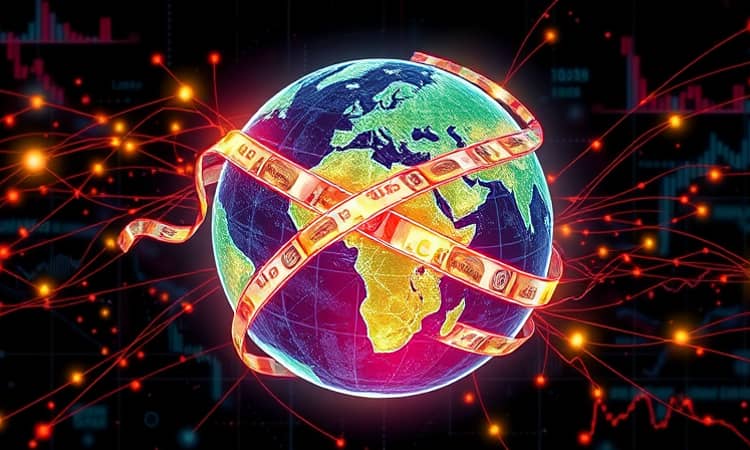
Global capital markets form a vast and intricate network that underpins today’s interconnected economy. They enable entities in one corner of the world to tap into funds and investment opportunities in another, facilitating unexpected collaborations and transformative projects. By tracing these invisible pipelines of money, we gain insight into how nations, firms, and individuals share resources, manage risks, and pursue growth.
In this article, we follow the winding trails of international capital flows, examining their historical roots, operating mechanisms, and real-life impacts. We also explore the role of major players, the rewards they reap, and the challenges they face, before casting a forward-looking glance at emerging trends and future prospects. Together, these perspectives offer a comprehensive portrait of how money moves across borders and shapes the global economy.
Historical Evolution
The story of cross-border finance dates back to the late 19th century, when advances in transportation and communication knit economies closer together. The post–World War II Bretton Woods system marked a turning point, introducing fixed exchange rates and creating institutions to govern global finance. Over the following decades, technological innovations and policy reforms gradually loosened capital controls, leading to spectacular growth driven by deregulation and innovation.
By the 1990s and early 2000s, measures like the US Gramm-Leach-Bliley Act (1999) dismantled barriers between banking, insurance, and securities services, fueling a surge in cross-border transactions. As global imbalances swelled from roughly 3 percent of world GDP in 2001 to over 6 percent by 2007, the world witnessed both the benefits and vulnerabilities of an integrated financial network. Crises in 1997 and 2008 underscored how rapidly financial distress could cascade through these channels.
Mechanics of Global Capital Flows
At the core of this system are various markets and instruments—equities, bonds, foreign exchange, and derivatives—that allow investors and issuers to match needs across jurisdictions. In primary markets, companies and governments raise fresh capital through IPOs, bond sales, and other offerings, while secondary markets channel liquidity by enabling the trading of existing securities. These operations facilitate efficient capital allocation for economic growth and help participants optimize their portfolios.
International capital flows typically take the form of foreign direct investment (FDI), portfolio investment, debt financing, and equity placement. They are recorded in the balance of payments framework, where the financial account tracks asset exchanges and the current account captures trade and income flows. The resulting interplay determines a country’s net borrowing or lending position over time.
Major Players and Scale
A diverse set of actors populate global capital markets, from individual investors and multinational corporations to central banks and supranational bodies. Institutional giants like pension funds, mutual funds, and sovereign wealth funds deploy vast sums in pursuit of yields and diversification. In 2022, the world economy surpassed $139 trillion, reflecting both domestic productivity and diversification across national and sectoral boundaries.
Institutions such as the International Monetary Fund and World Bank also shape flows through lending facilities and policy guidance. A notable example is GreenVolt, which issued €300 million in global bonds to fund renewable energy projects, attracting investors from the United States, Japan, and the Middle East. Such transactions illustrate how capital reach extends far beyond borders, aligning stakeholders around common objectives.
Benefits and Real-World Applications
Cross-border capital movements deliver multiple advantages to economies, firms, and investors. They enable governments to finance infrastructure and public projects while giving businesses access to deeper pools of capital than domestic markets alone can provide. Entrepreneurs leverage these channels to launch ventures in emerging hubs, fueling innovation and job creation.
- Supports infrastructure and public project financing
- Grants firms access to diverse and cost-effective capital
- Enables investors to spread risk globally
- Drives innovation in renewable energy and technology
Moreover, trade financing and foreign exchange services help companies manage currency risks, ensuring that importers and exporters can maintain stable cash flows. By channeling funds into strategic sectors—such as sustainable energy and technology—global capital flows also foster broader societal benefits beyond mere financial returns.
Risks and Challenges
Despite their upsides, international capital flows come with significant pitfalls. Financial shocks in one market can swiftly transmit through interconnected channels, threatening stability elsewhere. Sudden reversals of capital can leave emerging economies with spiraling debt burdens and currency crises, highlighting interconnected risks amplifying financial contagion.
- Volatility may lead to sudden capital flight
- Policy shifts and geopolitical tensions can disrupt flows
- Excessive debt accumulation risks borrower stability
Mitigation strategies include prudent macroeconomic policies, regulatory oversight, and risk-management tools such as derivatives and hedging instruments. Institutional cooperation—through bodies like the IMF and the Financial Stability Board—also enhances transparency and coordination during periods of stress.
Current Trends and Future Outlook
The landscape of cross-border finance continues to evolve under the twin forces of technology and sustainability. Digital platforms and blockchain-based settlement systems promise faster transactions and lower costs, while algorithmic trading reshapes market dynamics. This era is marked by sophisticated electronic trading and algorithmic platforms that democratize access and improve efficiency.
- Rise of fintech and blockchain-based settlement systems
- Growing emphasis on ESG and sustainable finance initiatives
- Entrepreneurship facilitated by global venture capital networks
Looking ahead, stakeholders aim to balance integration with resilience by strengthening regulatory frameworks and stress-testing financial infrastructures. Initiatives like the Global Connect partnership bring together governments, investors, and entrepreneurs to foster inclusive growth and ensure that capital flows support long-term development goals.
Conclusion
Following the pathways of global capital reveals a tale of opportunity, innovation, and risk. From the factories built by FDI to the renewable projects financed by bond issuances, each flow weaves into the broader narrative of human progress. Yet, the same connections that unlock growth can also transmit shocks, demanding vigilant oversight and cooperation.
By embracing multi-stakeholder cooperation for sustainable finance—from policymakers to private investors—we can harness the full potential of international money movements. In doing so, we chart a course toward resilient, inclusive, and sustainable economic development for generations to come.