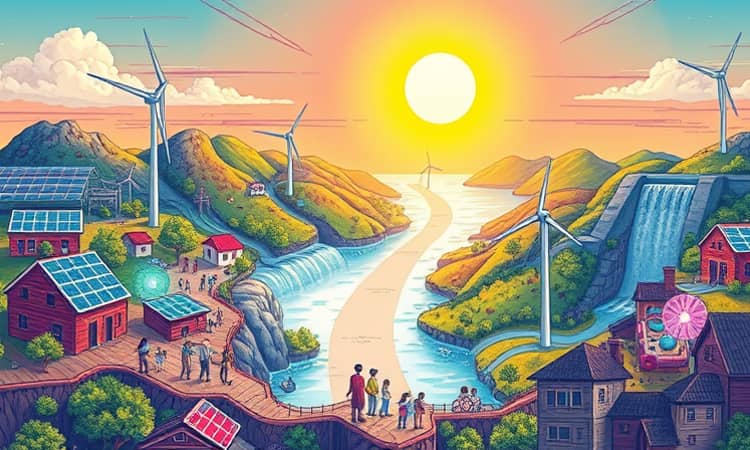
The world stands at a pivotal crossroads, where the very fabric of our energy systems is being rewoven with threads of innovation and urgency.
This evolution transcends mere technological advancement; it is a profound societal shift towards sustainability that will define our legacy for centuries.
With record renewable capacity growth accelerating globally, we are witnessing a transformation that promises both challenges and unprecedented opportunities.
As electricity demand soars and climate concerns mount, the landscape is ripe for those ready to engage and innovate.
The Unstoppable Rise of Renewables
In 2024, global renewable capacity expanded by a staggering 510 gigawatts, marking the fastest growth rate in history.
This momentum is set to continue, with projections of 520 GW added in 2025, comprising over 90% of all new power capacity.
By 2025, total renewable capacity will reach approximately 5,800 GW, up from 4,200 GW in 2023, and is on track to triple 2015 levels by 2030.
Solar energy dominates this surge, accounting for about 75% of additions in 2025, while wind power shows signs of robust recovery.
Currently, renewables generate 30% of global electricity, a share expected to rise to 42–45% by 2030, signaling a decisive shift in the power mix.
This rapid expansion is fueled by several interconnected drivers that are reshaping our energy future.
- Accelerated electrification across sectors, from transportation to industrial processes.
- Economic growth in emerging markets boosting energy consumption.
- Increasing cooling demands due to escalating climate change impacts.
- The proliferation of electric vehicles and data centers, especially in tech hubs.
- Advancements in artificial intelligence enhancing grid efficiency and management.
These factors combine to create a virtuous cycle of innovation and adoption.
Global Electricity Demand and Emissions Pathways
Global electricity demand is experiencing a significant surge, with a 4.5% increase anticipated in 2025 compared to 2024.
Growth is projected to continue at a rate of at least 2.8% annually through 2030, driven by diverse and powerful forces.
Key drivers include the electrification of transport, the expansion of data centers in regions like the US and Europe, and rising industrial activity in developing nations.
Despite this growing demand, ambitious climate scenarios offer hope for substantial emissions reductions.
Over 90% drop in CO₂ emissions by 2050 is achievable through a combination of efficiency gains, renewable energy adoption, and carbon capture technologies.
Fossil fuels, while gradually declining, are expected to retain a significant share of the energy mix beyond 2050, with coal demand potentially falling by 28–93% by mid-century.
Natural gas may see growth in some scenarios, displacing coal but requiring careful management to align with climate goals.
Regional Dynamics in the Energy Shift
The energy transition is unfolding at varying paces across different regions, creating a mosaic of leadership and challenges.
To grasp this complexity, consider the following regional breakdown, which highlights key stats and drivers.
China, the US, Europe, and India collectively account for about 90% of renewable growth to 2030, underscoring the concentration of progress.
This regional leadership is crucial but must be complemented by efforts to ensure equitable access worldwide.
Fueling the Future: Investment and Innovation
Record clean energy investments are the engine driving this transition, with funds flowing into renewables, nuclear, hydrogen, and carbon capture.
In the US, the Inflation Reduction Act has unleashed a wave of private investment, while global initiatives like those from IRENA are shaping the financial landscape.
Technological advancements are at the heart of this evolution, offering tools to overcome existing barriers.
- Dominant solar and wind power are leading the charge, with variable renewables often paired with gas for reliability.
- Growth in firm clean sources such as nuclear, geothermal, and hydro provides stable baseload power.
- Batteries and pumped storage systems are essential for grid stability and energy storage solutions.
- Carbon capture and storage is reaching a turning point, with capture capacity set to quadruple by 2030.
- Artificial intelligence applications optimize renewable integration and carbon management processes.
- Cleantech manufacturing and hybrid energy systems enhance efficiency and resilience.
Efficiency improvements remain a cornerstone, helping to plateau energy demand and slash emissions across sectors.
Policy and Governance: Navigating Complex Scenarios
Policy frameworks play a decisive role in steering the energy evolution, with varying scenarios outlining possible futures.
Tailwinds include supportive policies in major economies like China, the EU, and the US, which have catalyzed over 90% of new renewable capacity.
However, headwinds such as energy security priorities, policy shifts post-elections, and trade disputes pose significant challenges.
Key policy scenarios illustrate the range of outcomes we might face.
- Reference or evolving scenarios feature slow demand growth, with coal declining but oil and gas remaining steady or rising.
- Ambitious climate scenarios target a 90%+ emissions cut by 2050, with renewables leading and coal near-zero in the power mix.
- Continued momentum scenarios, like those from McKinsey, show fossils plateauing by 2030–2035 with natural gas growth.
Understanding these pathways is vital for stakeholders to align strategies with long-term sustainability goals.
Challenges and Practical Opportunities
Despite the progress, the energy transition faces formidable obstacles that require collective action and innovation.
Critical challenges include grid constraints, permitting delays, and financing gaps in developing economies.
Record CO₂ emissions and uneven regional access to clean energy further complicate the landscape.
- Grid modernization is urgently needed to handle intermittent renewable sources effectively.
- Permitting processes must be streamlined to accelerate project deployment.
- Investment in infrastructure for developing regions is essential to meet sustainable development goals.
- Trade disputes, such as tariffs on clean tech, can hinder global collaboration and market growth.
Yet, within these challenges lie immense opportunities for individuals, businesses, and communities to thrive.
Practical steps to seize these opportunities include investing in renewable energy projects and green technologies.
Adopting electrification in homes and vehicles reduces carbon footprints and energy costs.
Leveraging AI for energy management can optimize consumption and support grid stability.
Supporting policies that promote clean firm power and carbon capture initiatives drives systemic change.
Advocating for equitable access ensures that the benefits of the energy evolution are shared globally.
A Call to Action for a Sustainable World
The energy evolution is not a distant abstraction; it is a tangible, unfolding reality that demands our engagement and creativity.
By embracing renewable energy sources and innovative technologies, we can build a resilient and equitable energy system for all.
This moment calls for inspired action, where every contribution—whether through investment, adoption, or advocacy—shapes our collective future.
Together, we can transform challenges into catalysts for progress, ensuring that the changing landscape leads to prosperity, sustainability, and hope for generations to come.
Let this be our legacy: a world powered by clean, abundant energy, where opportunity knows no bounds.