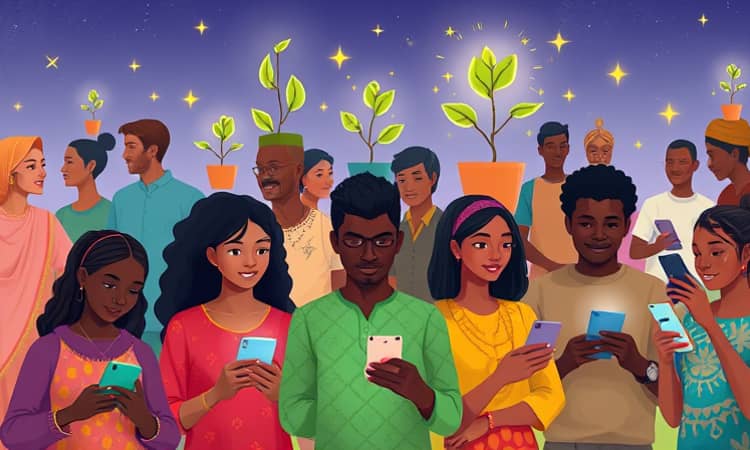
Imagine a world where 1.3 billion adults live without access to basic financial services.
This staggering reality persists globally, yet hope is rising through technological innovation.
FinTech is rapidly changing the landscape, pushing financial inclusion to record-high levels and offering a beacon of opportunity.
From mobile money in Africa to digital payments in Asia, the journey toward empowerment is accelerating.
This article delves into the scale, innovations, and human stories behind this transformation.
The Global Scale of the Unbanked Population
Despite progress, the unbanked population remains a critical global issue.
Over half of these individuals are concentrated in just eight countries.
- Bangladesh
- China
- Egypt
- India
- Indonesia
- Mexico
- Nigeria
- Pakistan
These regions highlight the concentrated challenges in financial access.
Alternative estimates suggest the number could be as high as 1.7 billion.
Demographics reveal deeper layers of exclusion.
Women make up 55% of the unbanked, often facing systemic barriers.
Poverty and low education further compound these issues.
- 52% come from the poorest 40% of households.
- 62% have primary education or less.
- 54% are unemployed or out of the labor force.
These factors create a cycle that FinTech aims to break.
FinTech Innovations Driving Inclusion
Mobile money has emerged as a key driver of change in developing economies.
It enables savings and transactions without traditional bank infrastructure.
In Sub-Saharan Africa, account ownership surged to 58% due to mobile solutions.
- 15% of global adults now have mobile money accounts.
- 10% in developing economies use them for saving, up 5 points.
- Digitally enabled accounts now exceed 50% in low- and middle-income economies.
Real-time payment systems like India's UPI and Brazil's PIX are revolutionizing access.
They allow low-cost, instant transactions for the unbanked.
Fintech lending, including BNPL and P2P platforms, is expanding credit opportunities.
- BNPL reached a transaction value of $350 billion in 2024.
- P2P and marketplace lending hit $62 billion.
- In Sub-Saharan Africa, fintech funding for micro-enterprises soared from 13% to 88%.
Digital wallets are expected to be adopted by 5.6 billion people globally.
This growth underscores FinTech's transformative potential for underserved communities.
Regional Progress and Variations
Financial inclusion varies widely across regions, each with unique trends.
The table below summarizes key data on account ownership and innovations.
Phone ownership plays a crucial role in these disparities.
Only 75% of those with primary education have phones, compared to 93% with secondary education or higher.
This digital divide impacts financial literacy and access significantly.
Demographic Barriers to Financial Access
Multiple factors hinder financial inclusion, creating complex barriers.
Low income and unemployment are primary obstacles for many.
- Low education levels limit understanding of financial products.
- Race and ethnicity contribute to persistent gaps in places like the US.
- Disability and non-citizen status further marginalize individuals.
- Lack of digital access, including smartphones and internet, is a major hurdle.
Gender disparities remain stark, with women's deposits at 64% of men's.
Their loans are only 46% of men's, highlighting systemic inequalities.
In the US, 21 million are unbanked, partly due to lack of identification.
Financial literacy gaps exacerbate these issues, leading to risks like fraud.
Micro-enterprises, often informal, struggle to access formal services.
- 345 million out of 400 million micro-enterprises in emerging markets are informal.
- This limits their growth and stability.
Addressing these barriers requires tailored, inclusive solutions.
Success Stories and Positive Trends
Despite challenges, inspiring progress is being made worldwide.
The gender gap is narrowing, with women's account ownership rising from 37% in 2011 to 73% in 2024 in low- and middle-income economies.
This marks a significant leap forward for equality.
Formal savings have increased by 16 points in a decade, reaching 40%.
Digital payments are now used by over 60% of adults in these economies.
Mobile phone ownership among the unbanked offers a digital pathway.
- 900 million unbanked individuals own mobile phones.
- 530 million have smartphones, enabling access to FinTech apps.
In India, initiatives like UPI have boosted account ownership to 90%.
These stories showcase how technology can convert potential into reality.
Challenges and Risks in Digital Finance
As FinTech expands, it brings new challenges that must be addressed.
The digital divide persists, with rural areas often lagging in infrastructure.
- High costs and regulatory hurdles slow adoption.
- Predatory lending and fraud pose significant risks to vulnerable users.
- BNPL schemes can be opaque and off credit registries, leading to debt.
- Identity theft is a growing concern with digital transactions.
Financial literacy is crucial; low skills increase susceptibility to scams.
Structural issues, such as unexplained racial gaps, require deeper policy attention.
Bank proximity is becoming less relevant with mobile solutions, but access remains uneven.
Cybersecurity threats demand robust protections for users.
These risks highlight the need for responsible innovation and regulation.
The Future Outlook and Policy Recommendations
The future of financial inclusion hinges on continued innovation and supportive policies.
World Bank President Ajay Banga emphasizes that digital finance can transform economies.
Bill Gates notes the clear case for investing in inclusive systems.
Key recommendations include enhancing digital public infrastructure.
- Implement digital IDs to verify identities securely.
- Expand cash transfer programs to reach the poorest.
- Modernize payment systems for efficiency and accessibility.
- Boost financial and digital literacy through education initiatives.
- Strengthen regulations to protect consumers and promote fairness.
FinTech's role is to bridge gaps, offering tools that empower individuals.
By focusing on connectivity and innovation, we can build a more inclusive world.
This journey is not just about numbers; it's about improving lives and fostering growth.
With collective effort, the unbanked can step into a future of financial security.