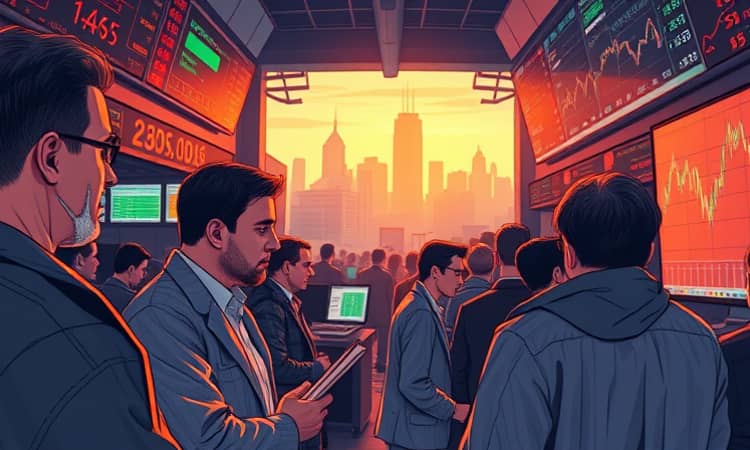
As 2026 unfolds, investors and traders alike face a landscape shaped by last year’s robust rally and lingering uncertainties. After closing 2025 with substantial annual gains of +17.8%, the S&P 500 slipped below key thresholds during the holiday season. These movements offer valuable lessons for those seeking to thrive in a dynamic market environment.
Drawing on insights from the trading floor, this article explores pivotal trends, strategic approaches, and risk management techniques to help you navigate the evolving financial ecosystem with confidence and purpose.
Market Patterns and Historical Lessons
On January 2, 2026, the S&P 500 ended at 6,858.47, breaking a three-week advance during the failed Santa Claus Rally. Yet the index remains above long-term trend lines, signaling underlying strength. Historically, these post-holiday downturns can precede heightened volatility in the first quarter, often presenting contrarian opportunities for disciplined investors.
Technical indicators illustrate the current backdrop:
Since April 2025, the market has been consolidating from April 2025 lows, carving a foundation for potential breakouts. Mega-cap technology and communications stocks have driven much of the recent rally, while cyclicals and small-caps lag. Understanding these sector rotations is critical for positioning your portfolio.
The technical composite reading at 72.28 remains bullish but weakening, prompting a balanced approach. Sector shifts into energy, materials, and industrials signal early rotation, while communications and technology may require profit-taking or selective participation.
Key Indicators to Watch
- ISM Manufacturing Index: Gauge factory activity and supply chain momentum.
- ADP Employment and ISM Non-Manufacturing: Assess labor resilience and service-sector growth.
- Credit Spreads: tight credit spreads forecast at 300 bp could signal changing risk sentiment.
- Inflation Measures: Watch for signs of softening labor market conditions and cooling price pressures.
Strategies for Navigating 2026
With US equities expected to lead globally in earnings growth, focus on sectors poised to benefit from robust domestic demand. Energy, materials, and industrials have outperformed early in the year, reflecting both cyclical recovery and new infrastructure projects.
Alternative investment vehicles, such as defined outcome ETFs and private credit, have seen surging interest as investors seek customized payoffs and yield enhancement. Consider blending these with traditional equity exposures to smooth volatility and capture yield in a low-rate environment.
- Embrace thematic allocations around AI and technology adoption.
- Position around rotation into defensives possible if market breadth narrows suddenly.
- Balance growth and value exposures to mitigate sector-specific risks.
- Exploit short-term volatility with disciplined entry and exit rules.
Actionable Strategies and Pitfalls
- Define clear entry and exit points: Avoid emotional trading by setting precise levels.
- Diversify across geographies: While the US leads, emerging markets show AI-driven dispersion across asset classes.
- Monitor policy shifts: Central bank signals can create rapid repricing events.
- Avoid overleveraging: Rising default risks underscore the need for prudent capital management.
Risk Management and Resilience
Market volatility is an inevitable companion to opportunity. By incorporating insights built on resilient economic fundamentals into your analysis, you can distinguish temporary setbacks from meaningful reversals. Setting stop-loss thresholds, using hedges like put options or inverse ETFs, and maintaining adequate cash buffers are all integral to sustaining long-term growth.
Hedging strategies can range from simple index puts to more complex pair trades. For example, pairing a long position in cyclical stocks with a hedge via utility sector ETFs may reduce correlation with broad market swings while preserving upside in recovery scenarios.
Another key aspect is scenario planning. Craft investment theses for varied outcomes—strong growth, mild recession, inflation resurgence—and outline corresponding portfolio adjustments. Keeping an investment journal to track decision drivers, emotional responses, and performance outcomes fuels continuous improvement.
Lessons from the Trading Floor
Traders often say that markets reflect human psychology as much as economic data. Stories of last-minute block trades moving millions in debt issuance or sudden M&A rumors shaking regional bank stocks underscore the importance of agility and situational awareness. In early 2026, several themes stand out:
One trader recalls a sudden spike in short-term funding yields, triggered by a corporate debt maturity wall. Quick recognition allowed reallocation into cash equivalents before spreads widened significantly. These real-time stories underscore the value of monitoring funding conditions alongside asset-price signals.
Further, the rise of defined outcome ETFs and hybrid funds highlights the growing demand for tailor-made risk-return profiles. Meanwhile, M&A plays in financial services and tech sectors continue to reshape competitive dynamics, offering both opportunity and cautionary tales.
Embracing a Forward-Looking Perspective
Looking ahead, geopolitical considerations, such as potential tariff shifts and supply chain realignments, will remain integral to equity valuation. An agile playbook that incorporates these variables, along with robust scenario analysis, can turn uncertainty into actionable frameworks.
As you chart your course through 2026, remember that markets are dynamic ecosystems. While past performance offers context, it does not guarantee future results. Cultivating adaptability is as important as honing analytical skills.
Stay curious, revisit your hypotheses, and seek diverse perspectives. Whether you’re an active trader or a long-term investor, weaving lessons from the trading floor into your decision-making fabric can yield profound insights and lasting success.
Effective market navigation strategies stem from a blend of data-driven analysis, disciplined execution, and emotional resilience. Let the stories from recent market inflection points guide your strategy, and approach every turning point as an invitation to refine your approach. In a world of constant change, the greatest edge comes from continuous learning and unwavering purpose.
Your mission: remain vigilant, flexible, and purposeful. Let the narratives of those on the trading floor guide you as you write your own capital chronicle in 2026.